
Why Cognitive Flexibility Matters for Peacebuilding
How to Engage Competing Perspectives in Good Faith

Alongside moral imagination, peacebuilders also must cultivate intellectual virtues that foster cognitive flexibility—the capacity to step beyond habitual patterns of thought in order to engage the merits of diverse perspectives with sincerity and openness.
Cognitive flexibility equips peacebuilders to engage in conflict in a manner that avoids the twin shoals of indifference and apathy on the one hand, and dogmatism and hubris on the other. While the conflict averse might view disagreement as being disagreeable, individuals who are conflict-engaged know how to advocate for their convictions and communities without backsliding into dogmatism.
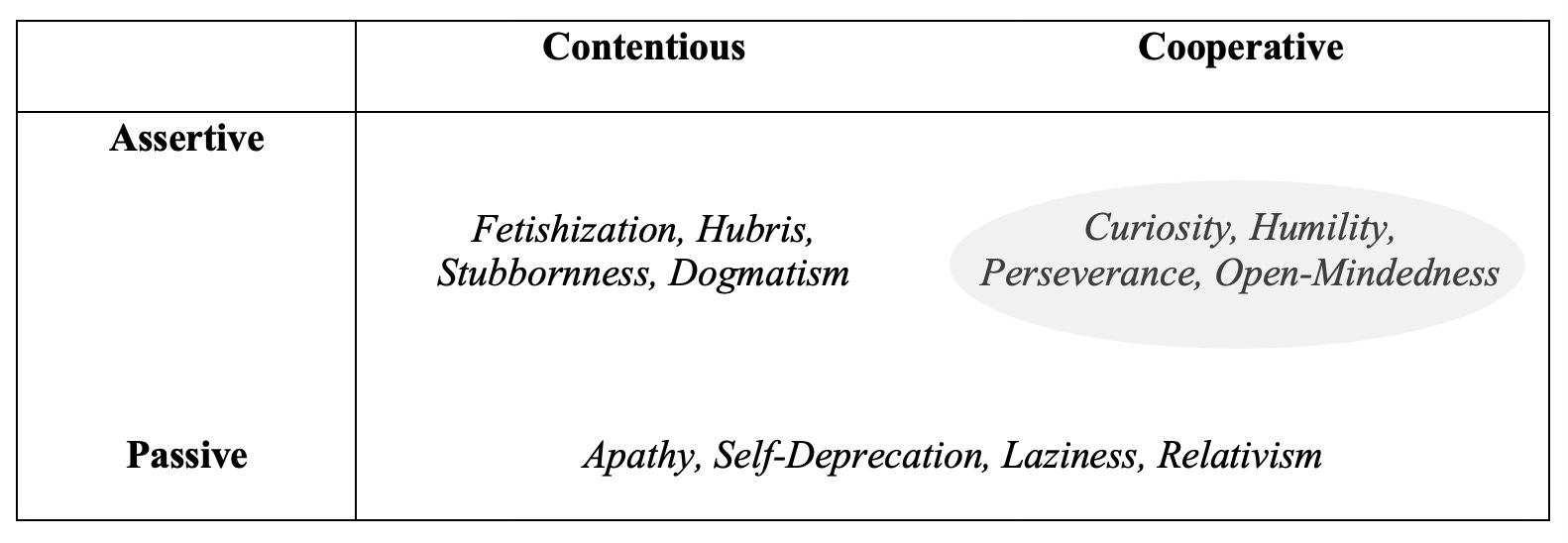
During conflict, a commitment to intellectual virtues can create tension with how peacebuilders relate to different stakeholders. Consider the role of conflict narratives, or stories that groups tell themselves about who are the perpetrators or victims of a conflict, as well as a vision of settling a conflict on just terms. During fieldwork in Lebanon, I learned about the difficulty public school teachers face about teaching the origins of recent conflicts, even in post-conflict settings. Despite the end of Lebanon’s civil war in 1990, as of writing there remains a lack of consensus of which narratives represent “truthful” public accounts of the conflict’s origins.1 In the Lebanese context, then, teachers who cultivate the character of peace require a unique disposition able to balance cognitive flexibility, humility, courage, and solidarity.
First, peacebuilders desiring cognitive flexibility must nurture curiosity, even as they gain practical experience, academic expertise, and professional competence. Curiosity is the disposition to pursue new knowledge, deepen existing understanding, and sustain a sense of wonder about the world. In the context of peacebuilding, curiosity equips individuals to practice healthy conflict when they inhabit an “exploratory desire to learn,” rather than an “aversion to not knowing something,” motivated by the desire to “squelch the discomfort of uncertainty.”2 Professor Thalia Wheatley’s research suggests that people who are curious about others’ worldviews are more likely to create alignment in their group. “[Curiosity] really creates common ground across brains, just by virtue of having the intellectual humility to say, ‘Okay, I thought it was like this, but what do you think?’ And being willing to change your mind,” Wheatley explains.
The virtue of curiosity is especially important for the analytical tools required in peacebuilding vocations. For peacebuilders engaging in “measurement, evaluation and learning” (MEAL), for example, analysts commonly seek to evaluate a program’s impact by first identifying and operationalizing difficult-to-measure concepts such as social trust. For example, peacebuilding scholar and practitioner Rebekah Wolfe at MercyCorps lead a multi-year effort to understand how to deescalate conflict among armer-herder tensions in North Central Nigeria. Key to this effort was to design survey questionnaires and behavioral experiments which could measure how social trust among adversaries changed as a function participating in community-based dialogue and mediation training.3
Alongside curiosity, humility is vital for transforming conflict. Humility is the disposition to identify and assess the limits of one’s knowledge and cognitive abilities, while remaining open and courageous to the pursuit of continued learning and growth.4 Humility requires properly calibrated confidence, not certainty. In order works, it reflects a careful balance between self-deprecation on the one hand, and hubris on the other. As such, the cultivation of humility requires a docile disposition, or a “keenness to be instructed by others and a desire to obtain true knowledge,” observes Josef Pieper.5
The virtue of humility is particularly important for peacebuilders who seek to cultivate academic expertise in peace and conflict studies alongside practical experience in the field. During my research trip to Iraq in December 2018, for example, I was surprised to learn how much of my academic knowledge of the country’s recent political and military history both informed but also blinded me to the realities of ordinary Iraqis trying to navigate life in conflict-affected communities.
For example, while I recognized that Iraq’s ethnic and religious minorities had to balance pressure from both the central government in Baghdad and the Kurdish Regional Government in Erbil, I failed to appreciate the key differences in the political preferences of minority groups who stayed in their communities during the ISIL occupation from those who fled to the Kurdistan Region.6 I came home from that trip with a more sober assessment of how far my academic training would take me in understanding the intricacies of postwar Iraqi politics.
Third, peacebuilders must develop intellectual perseverance by diligently “overcoming obstacles to gaining, retaining, and sharing knowledge.”7 Similar to emotional resilience and relational forbearance, perseverance requires wellsprings of curiosity, humility, and hope to continue down the path toward wisdom “with serious effort, despite obstacles to success that make success difficult.”8 For peacebuilder practitioners, in particular, perseverance is necessary because progress toward conflict transformation is often measured in decades as opposed to weeks or months. In short, a commitment to peace in conflict-affected communities requires a “long obedience in the same direction.”9
Intellectual perseverance can take a variety of forms in the context of conflict transformation. For example, the cultivation of expertise—in mastering a foreign language like Arabic, Chinese, or Russian, or building competence in advanced statistical methods—requires schooling commitments measured in decades as opposed to two- or four-year blocks. Similarly, for practitioners, building expertise in mediation requires not only formal training, but also thousands of hours of applied experience mediating real disputes. In either setting, intellectual perseverance is required alongside
Finally, effective peacebuilders exhibit open-mindedness: the willingness and capacity to step outside of ingrained habits of thought to engage the merits of different perspectives with the goal of re-calibrating toward a more truthful or holistic understanding of the conflict. Open-mindedness allows individuals to embrace paradox and complexity, including, in Lederach’s words, the ability to hold “multiple and even competing and contradictory needs and perspectives together at the same time . . . without losing one’s identity and viewpoint and without needing to impose or force one’s view on the other.”10 As with the virtues of humility, curiosity, and perseverance, an individual’s willingness to tolerate uncertainty and dissonance plays a significant role: “What we find is that people who are stress tolerant—who have a willingness to sit with uncertainty—are exploratory in their conversations,” observes Professor Thalia Wheatley.11
Much like building aerobic stamina or muscle strength, peacebuilders cultivate cognitive flexibility by “stress testing” their worldview/assumptions/beliefs in settings which present the strongest versions of arguments that generate cognitive dissonance and a temptation to shut down and disengage. By engaging in debate, dialogue, or even simply conversation, individuals are given an opportunity to re-articulate their own convictions as well as remain open to changing their minds. As Monica Guzmán explains: “Big, tough questions are big, tough questions. You’ll want to take shortcuts. Close doors. Simplify. But there is no simplifying tough issues while still getting them right. You need the friction.”12
In September 2025, for example, the HPI collaborated with College Debates and Discourse Alliance (CD&DA) to host a “Braver Campus Dialogue” on the topic of how the USU community should respond to controversial speakers. Despite being scheduled before the political assassination of Charlie Kirk on the campus of Utah Valley University (UVU) on September 10th, the dialogue had higher stakes since Kirk was supposed to speak on USU’s campus on September 30th. The dialogue’s format and decorum encouraged students to lean into their disagreements, allowing them to take risks in a controlled setting with a trained facilitator. As one student participant remarked after the fact, “I urge students to channel the discomfort they feel when confronted with opposing views into positive action. That energy can fuel meaningful long-lasting change for our futures far more effectively than anger or violence ever could.”13
Sana Richa Choucair, “A New Approach to Teaching History: Will Lebanon’s Schools Embrace Multiple Narratives?”, This is Beirut, April 13 2025, https://thisisbeirut.com.lb/articles/1312729/a-new-approach-to-teaching-history-will-lebanons-schools-embrace-multiple-narratives.
Annelise Jolley, “Curiosity Has Two Faces,” John Templeton Foundation, August 8 2025, https://www.templeton.org/news/curiosity-has-two-faces.
C. Reardon, R. Wolfe, and E. Ogbudu, Can Mediation Reduce Violence? The Effects of Negotiation Training for Local Leaders in North Central Nigeria. Washington, DC: Mercy Corps, April 2022). https://www.mercycorps.org/sites/default/files/2022-04/Can-Mediation-Reduce-Violence-Full-Report.pdf
King, Nathan L. The Excellent Mind: Intellectual virtues for everyday life. New York: Oxford University Press, 2021.
Josef Pieper, 1985. “The Art of Making Right Decisions.” In Problems of modern faith: Essays and addresses (JanVan Heurek, Trans.). Chicago: Franciscan Herald Press, p 225.
Knuppe, Austin. Surviving the Islamic State: Contention, Cooperation, and Neutrality in Wartime Iraq. Columbia University Press, 2024. See chapter 5.
Nathan King, Excellent Mind, ch. 8
Ibid, p. 160
See Peterson, Eugene H. A long obedience in the same direction: Discipleship in an instant society. InterVarsity Press, 2019.
Lederach, The Moral Imagination, 62.
Annelise Jolly, “Curiosity has two faces,” Templeton Ideas, August 8, 2025. Accessed at: https://www.templeton.org/news/curiosity-has-two-faces.
Guzmán, Mónica. I never thought of it that way: How to have fearlessly curious conversations in dangerously divided times. New York: BenBella Books, 2022, p. 69.
Student testimonial, Braver Campus Dialogue, 9/23/25